

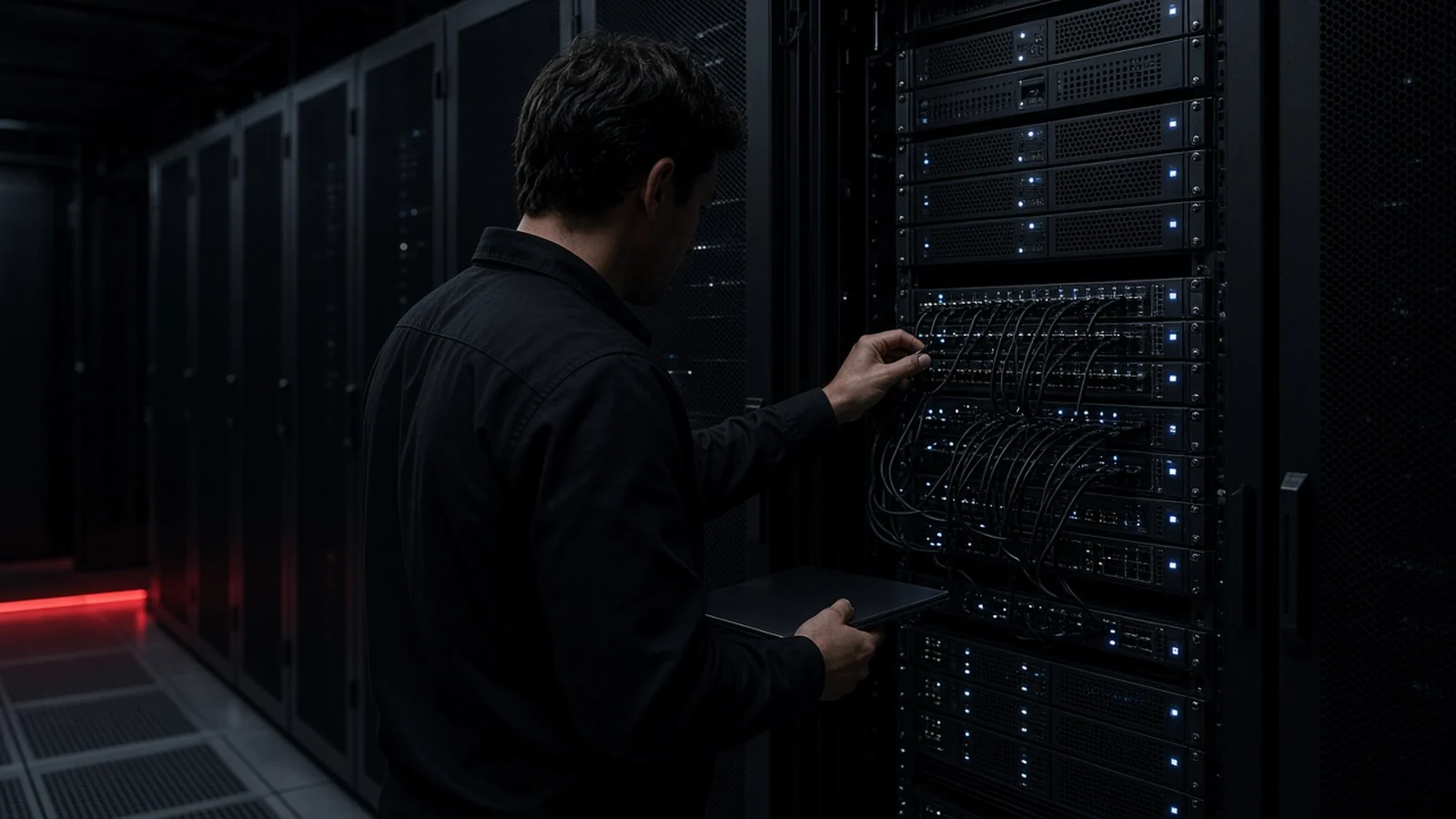
A colocation operator in Astana usually needs two answers at once: who may approach the rack, and what the site will do if the team does not fly in. On the Akashi Data Center campus (street C316, site 7) those are not one product. Remote hands is around-the-clock help by on-site staff. Access is who enters a cabinet, a cage or a hall. The formats are server cabinet rental, a private cage and a dedicated server room. Until May 2027 the conversation is a reservation of that mix, not work inside a hall already handed over.
What follows stays inside the site’s wording and already published pieces. There is no catalogue of remote-hands tasks, no reaction time in minutes and no call-out tariff on the site.
Remote hands and your own visit are different contours
On the Akashi site remote hands is named as technical operations and on-site assistance, available 24/7. For a cabinet the wording is already specific: agreed work is done without handing out extra keys. On the dedicated-hall page support is named around-the-clock, on site; the service card says “24/7 on-site support”.
A visit by your people is a different contour. Names on your list cross a perimeter: a coded cabinet door, a cage zone or an access-controlled hall. If remote hands does not cover the actions you need, the TCO structure lists engineer travel as a separate line. Do not treat them as one row in the request: they are different contract lines.
The site does not publish a mandatory Akashi pack such as “disk swap / recabling / visual check”. Those examples appear in general colocation guides; for this campus the scope is discussed with sales.
Coded cabinet, cage perimeter, hall with desks
The campus physical contour is shared: multi-layer access control and 24/7 CCTV. The formats then split.
A cabinet: 1200 mm width, coded access, dual PDUs, controlled access to each rack. Remote hands here covers agreed work, not keys for everyone. The commercial step starts at one cabinet; the rack as a product is in the server rack rental piece.
A cage: an isolated slice of the hall, a stronger perimeter, entry only for authorized staff, 24/7. That is not a keypad code on a single door. How the zone is built is in cage colocation in Astana.
A dedicated hall: access-controlled rooms run around the clock, on-site desks are provided for the team, and access engineering is tuned to the room. The hall as a product is in dedicated server room rental in Astana.
The admitted-people list and whether the team needs a standing on-campus workplace belong in the reservation, not “on the unloading dock”.
Where this sits in the contract and in TCO
Remote hands and access are not a footnote after kilowatts. In the SLA checklist they sit among six items to see before signature: next to availability, power per rack, incident response and acceptance. The contract is where you look for whether the service is around the clock, which operations are in, how a ticket is raised and what counts as agreed work. Reaction time in minutes is not published: if it matters, it belongs in the contract text.
In the TCO structure space and power are the standing part of the bill; cross-connects and remote hands are the variable part. Installation, storage and extra passes may be billed separately. The site publishes no figures and no shop-window list prices.
Acceptance in the same checklist is the moment the handed-over space matches the reservation: power, cooling, access perimeter, the people list and the remote-hands task list. The site does not publish an acceptance form.
May 2027: a reservation, not a live hall. TCDD is not TCCF
Phase one launches in May 2027. Until that date Akashi agrees a configuration: the format (cabinet / cage / hall), who enters, which actions you expect from the campus. That is not a move-in to an open hall and not a handover certificate. Public build progress sits on construction-progress.
Phase-one design documents hold Uptime TCDD Tier IV. TCDD confirms the design, not the built hall. TCCF is a separate on-site audit, dated April 2027 on the calendar; there is no TCCF certificate today. TCDD is not TCCF. The Tier IV topology calculation is 99.995%: that is a topology figure, not a measured outage and not a remote-hands SLA number.
What to put in the request
The form is contacts, consultation block. It helps to name at once: rack count or zone type (cabinet / cage / hall); whether your own team needs on-site access; which actions you expect from campus staff; the date relative to May 2027. Sales replies within one business day, runs a pre-qualification and a capacity check, and sends a proposal with prices, timelines and technical detail. There are no shop-window list prices. An NDA is available on request. Email and phone: sales.department@akashi.cloud, +7 700 810 3010.
Need remote hands and access locked in before the Astana hall opens? Use the request link above — we will go through the format, the entry list and the reservation before May 2027.
Frequently asked questions
What does the Akashi site call remote hands? Around-the-clock support for technical operations and on-campus assistance. The site does not publish a minute-by-minute work catalogue or a call-out price: scope is agreed with sales and written into the contract.
How is remote hands different from a visit by the client’s engineers? Remote hands is work by site staff on request. A visit is entry by people on your list. They are two contours: one does not replace the other in the contract.
How does access differ for a cabinet, a cage and a dedicated hall? A 1200 mm cabinet has coded access; remote hands does agreed work without extra keys. A cage is a perimeter for authorized staff only, 24/7. A hall has room-level access control and on-site desks for the team. The campus contour is shared: multi-layer access control and 24/7 CCTV.
Can remote hands already be ordered in a handed-over Akashi hall? No: phase one opens in May 2027. What is reserved now is the format, the access list and what the site will do on request. That is not a handover certificate.
Does TCDD mean access and remote hands already run in a built hall? No. TCDD certifies the design documents of phase one, not the constructed hall. The TCCF audit is planned for April 2027. TCDD is not TCCF.