

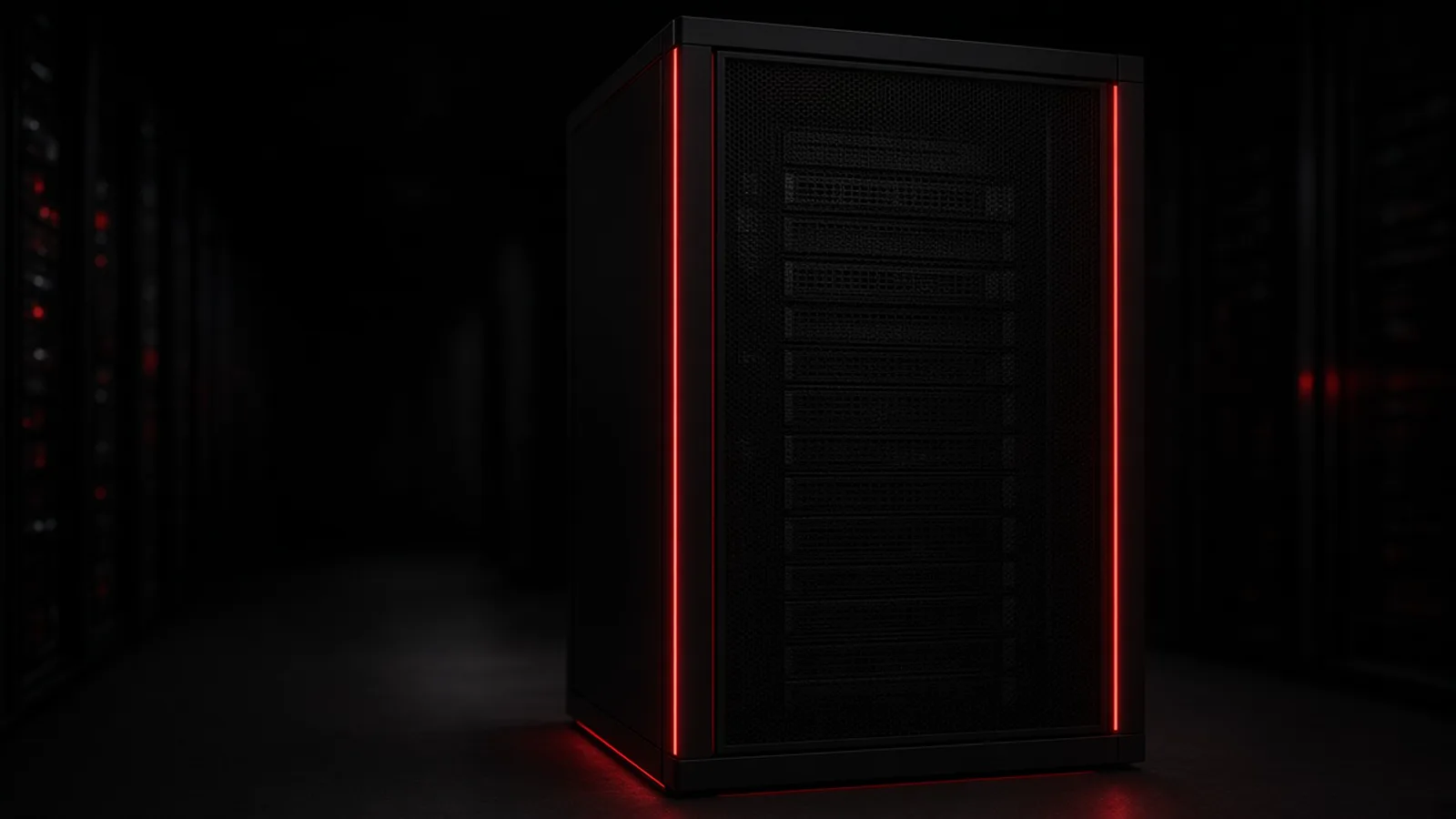
Server rack rental at a data center in Kazakhstan, at Akashi Data Center, is colocation in a ready cabinet on the Astana campus: the servers stay yours, and the site provides space, power, cooling and access. On the site the product is server cabinet rental: 1200 mm wide, coded access and dual PDUs. The first phase (DC-1) launches in May 2027, so the conversation now is a configuration and a capacity reservation, not installing hardware in a hall that is already open.
What is server rack rental?
Rack rental is colocation without capital expenditure. Equipment goes into a ready cabinet. The client pays for space, power and operations rather than building a hall. The servers and their configuration stay with the client. It is not rental of someone else’s server, and it is not a cloud, where the hardware belongs to the provider and the configurations are limited to that provider’s line.
The path from a request to a rack — cabinet, cage or dedicated room — is in Where to place servers in Kazakhstan. Criteria for choosing a site are in the colocation guide and in How to choose a data center. Below is what the Akashi cabinet itself provides.
What is in the cabinet?
The product page describes the cabinet as 1200 mm wide, with coded access, dual PDUs and support for high-density loads. Access to each rack is controlled. Support is stated as 24/7. “Fast deployment” is a description of the service, not a statement that the hall is already accepting equipment.
You can start with one cabinet. The commercial range runs from 1 to 1,000+. That range is commercial. It is not an engineering cap on the campus. The campus is planned for 4,224 racks across four data-center buildings. A non-standard size goes in a cage. A whole hall and custom engineering are a dedicated server room.
What power per rack is stated?
The cabinet rental page states up to 20 kW per rack, including AI/ML loads. That is the product wording. It is not a measured density of a handed-over hall.
Design supply is stated separately, by module. DC-1, the first phase, is up to 15 kW per rack at a design IT load of 5.28 MW. DC-2 and DC-3 are up to 30 kW and 12 MW of IT each. DC-4 is designed for high-density AI workloads and HPC: up to 150 kW per rack, liquid cooling, and design IT capacity of up to 30 MW. Design capacity of the complex after every phase is up to 100 MW. That figure is the whole project. It is not power already live in a hall.
The exact density for the chosen phase is confirmed when the configuration is sized. A rack above a module’s ceiling is not inferred from the “up to 20 kW” line on the cabinet page. The layout is in the Astana campus article and in the GPU cluster placement guide.
What power and cooling does the cabinet sit on?
The campus engineering the placement relies on:
- two independent power entries, active/active, with 110 kV redundancy;
- dual electrical redundancy per building;
- UPS with 5/4N redundancy and up to 10 minutes of battery backup;
- backup generators with 12 hours of autonomy at full load;
- two fuel suppliers, with a 4-hour delivery SLA;
- automatic failover and load balancing.
Cooling in the design: Astana’s climate allows free cooling for much of the season. Free-cooling and hybrid modes are designed to cut energy use by up to 40% against a conventional scheme. The target PUE is below 1.4. These are design targets, not a measurement of an operating hall. Liquid cooling in the campus description is tied to the DC-4 module and to high-density configurations. Until the hall is handed over, that loop cannot be described as already running. More is in the green engineering article.
Cabinet weight is worth checking against the stated floor load of 2 t/m² and the 1.6 m raised floor. The campus has two loading terminals with freight elevators.
How are access and support arranged?
Coded access on the cabinet, multi-perimeter access control on the campus and 24/7 CCTV. Remote hands performs agreed work around the clock, without handing out extra keys. The fire loop is triple-layer detection, gas suppression and dual redundancy on the suppression systems.
The site does not publish a contractual availability percentage for cabinet rental alone. The designed availability of a Tier IV topology is 99.995%. That is a topology figure. It is not a measured hall outage and not an SLA number on the cabinet page. What from the tier lands in a contract is in Tier III or Tier IV.
Where is the campus, and what does that mean for data in Kazakhstan?
The campus is street С316, site 7, Astana, Kazakhstan. That is Central Asia: four data-center buildings on 11 hectares. Four independent optical entries connect to the East–West digital corridor. The site works with several providers. The specific set of operators is not fixed in the general description; connectivity options are discussed individually.
Colocation gives the equipment a physical address in Kazakhstan. If the servers hold personal data, the law regulates where that data is stored. How that is stated for a server move is in the migration guide and in Data localization in Kazakhstan. Which data, and who is the owner or operator, is the company’s determination.
Regional risk, and why a backup site belongs in another city, is in the disaster-recovery lessons. That article does not replace an assessment of your own architecture.
When can equipment be installed?
The first phase launches in May 2027. Construction progress is published on the construction progress page. Until the hall opens, the conversation with the site is a configuration reservation, not a delivery slot.
Against the 5.28 MW design IT load of DC-1, 5.54 MW is reserved. The pre-launch pipeline is 107% of DC-1 capacity. Those are different quantities: 5.54 MW is the volume reserved, and 5.28 MW is the design IT load of the first phase.
The request goes on the contacts page. It helps to state the cabinet count, kilowatts per rack, the size (1200 mm or non-standard), whether a separate perimeter is needed, and the date relative to May 2027. Sales replies within one business day, by email and phone, runs a technical pre-qualification and an available-capacity check, and sends a proposal with prices, timelines and technical detail. The site does not publish list prices. An NDA is available on request. Directly: sales.department@akashi.cloud, +7 700 810 3010.
What does TCDD mean for a rack tenant?
The design documents of phase one hold Uptime TCDD Tier IV (Certification of Design Documents). That confirms the design, not the built hall. The on-site audit of the constructed facility — TCCF (Certification of Constructed Facility) — is planned for April 2027 and is not a certificate held today. TCDD is not TCCF. The Tier IV page explains how fault tolerance is defined in the standard.
Frequently asked questions
What is server rack rental at the Akashi data center? Server rack rental is colocation in a ready cabinet: the equipment stays yours, and you pay for space, power and operations rather than building a hall. At Akashi the cabinet is 1200 mm wide, with coded access and dual PDUs. The first phase launches in May 2027.
What power per rack is stated for the cabinet and for the modules? The cabinet rental page states up to 20 kW per rack, including AI/ML. The campus description states design supply by module: DC-1 up to 15 kW, DC-2 and DC-3 up to 30 kW, DC-4 up to 150 kW. The exact density for the chosen phase is confirmed when the configuration is sized.
When can equipment be installed, and how is capacity reserved? The first phase launches in May 2027. Until then, the configuration is reserved with sales. Against the 5.28 MW design IT load of DC-1, 5.54 MW is reserved; the pre-launch pipeline is 107% of DC-1 capacity.
How is the cabinet secured? Coded access on the cabinet, campus multi-perimeter access control and 24/7 CCTV. Remote hands performs agreed work around the clock, without handing out extra keys.
Does TCDD mean the hall is already certified as a constructed facility? No. Phase one holds Uptime TCDD Tier IV: certification of the design documents, not of the built hall. The TCCF audit is planned for April 2027. TCDD is not TCCF.
Need a cabinet in Astana? Send a request to sales — we will look at rack count, kilowatts and the reservation.