

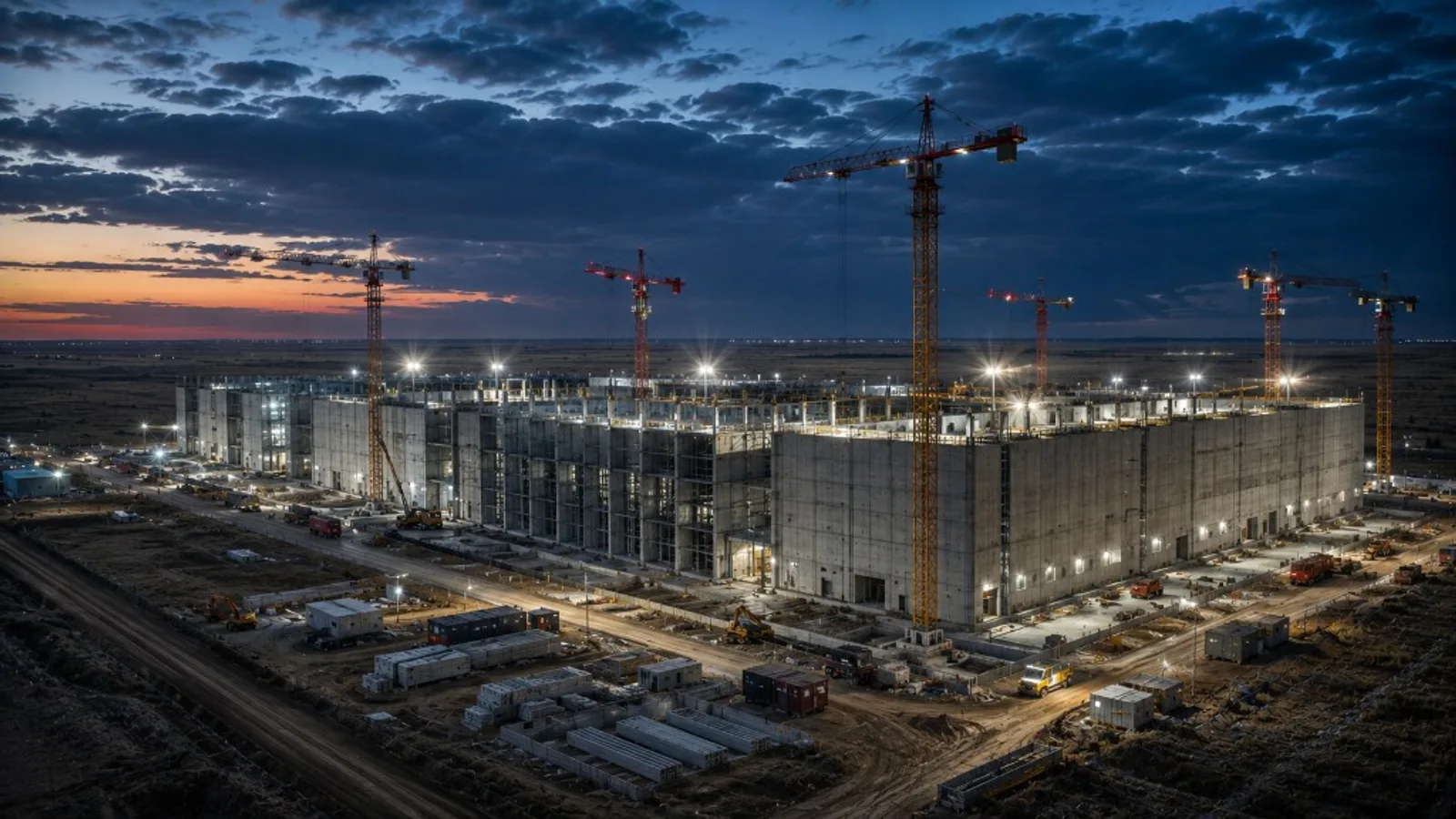
On 24 September 2026, a technical press tour in Astana showed construction of the Akashi Data Center campus. The same day, Kazinform and Bizmedia.kz reported on the site.
The campus covers more than 11 hectares. Total area is about 55,000 m²: Bizmedia.kz describes this as building area, Kazinform as infrastructure area. Investment in the project is $354 million (Bizmedia.kz says “approximately” that figure). The capital goes into data center modules, the site’s own power and telecom infrastructure, an administrative and business block, and other campus facilities.
Capacity and modules
At full build, design capacity is up to 100 MW. Bizmedia.kz, citing Akashi Data Center Chairman of the Board Vladislav Minkevich, reports a plan to place up to 4,224 server racks. Kazinform reports more than 4,000 racks once every phase is complete.
“Infrastructure is being developed in stages. The first module, DC-1, is sized for 5.28 MW of IT load. DC-2 and DC-3 are sized for 12 MW of IT load each. A separate DC-4 is designed for high-density AI workloads and high-performance computing. Its design IT capacity is up to 30 MW, and the engineering infrastructure provides for modern liquid-cooling technologies. This modular architecture lets the campus add capacity in step with demand from local and international clients,” Minkevich said.
Kazinform notes that the actual rack count depends on client requirements and power per rack. DC-1 can supply up to 15 kW per rack; DC-2 and DC-3 can reach up to 30 kW. The fourth module is aimed at high-density AI compute: up to 150 kW per rack. DC-4’s floor area is comparable to the first module, but in compute it is meant to be the most powerful building on the campus.
Tier IV Design for module DC-1
Design documentation for the first module, DC-1, is certified by the Uptime Institute to Tier IV Design. Kazinform reported the certification.
Chief commercial officer Erasyl Ayubekov:
“Tier IV is, first of all, full fault tolerance. The redundancy schemes let the facility keep running if individual parts of the system fail.”
Kazinform contrasts that with Tier III, which uses N+1 redundancy: Tier IV provides a higher level of engineering redundancy. According to the company representative, Akashi Data Center is meant to be one of the first facilities of this level in Central Asia.
Own substation and four fiber entries
The main power equipment of a 110/10 kV substation is already installed on site, and a dedicated power line has been brought in. The technical conditions allow power capacity to grow as later phases come online. Kazinform notes separately that the facility will not draw electricity set aside for the city’s current consumption; it will use capacity reserved for the project.
Power is backed up on several levels, including uninterruptible power supplies and diesel generators.
“If a cable or high-voltage line drops, power will be provided by diesel generators, UPS systems and other backup systems,” Ayubekov said.
The campus is being built as a carrier-neutral site. Vladislav Minkevich:
“The Akashi Data Center architecture provides four independent optical entries, with the ability to connect to several Kazakhstani and international telecom operators. The campus is developing as a carrier-neutral site: clients will be able to choose telecom partners and connection routes based on their own requirements for resilience, bandwidth and latency.”
Cloud, AI and the region
The site is aimed at Kazakhstani and international technology companies, cloud providers, telecom operators, financial institutions and operators of high-performance AI infrastructure. Ayubekov named cloud providers, large hyperscalers and companies working with artificial intelligence as potential clients — including global companies such as Google Cloud and Amazon, and other cloud and compute providers.
“The global trend is toward digitalization and artificial intelligence. For Kazakhstan, developing artificial intelligence will be a major step. But that requires the right infrastructure — data centers that can take large volumes of data and computing capacity,” he said.
Data types he said could be processed on this kind of infrastructure include mapping data, subsoil-use data, information for autonomous-driving systems, and data from urban digital systems, including Astana Smart City. He also named CDN providers as a separate track: hosting infrastructure inside the country lets in-demand content sit closer to the user.
“Our goal is for companies that localize here to build their IT infrastructure and provide their services to individuals and companies in our market and across Central Asia,” the chief commercial officer said.
Schedule and jobs
Commercial launch of the first phase is planned for 2027, the same window Kazinform gives for the first large clients. General construction of the first module is being finished on site, and engineering work is starting. Kazinform expects all four modules to be complete by the end of 2028 or early 2029.
Construction can be followed on the construction progress page.
The campus needs more than IT specialists. It also needs engineers for power, telecommunications, cooling, critical-infrastructure operations and information security — during construction and after launch.
“Akashi plans to help build a talent pool for Kazakhstan’s growing data center industry and to train about 200 specialists. What is more interesting is indirect employment. By our estimate, we indirectly create somewhere from 10,000 and up new jobs as new companies arrive and are created,” Minkevich said.
Sultan Dostanov, deputy chairman of the Astana Invest City Center for Investment Development, said Akashi Data Center is among the top three strategically significant investment projects in the Republic of Kazakhstan.
“Akashi is creating in the capital the new computing capacity needed to develop cloud technologies and artificial intelligence, and the conditions to attract international technology companies to Kazakhstan.”
Kurultai deputy Olzhas Nuraldinov added that Kazakhstan needs to move from talking about digitalization to the real infrastructure a digital economy is built on.