

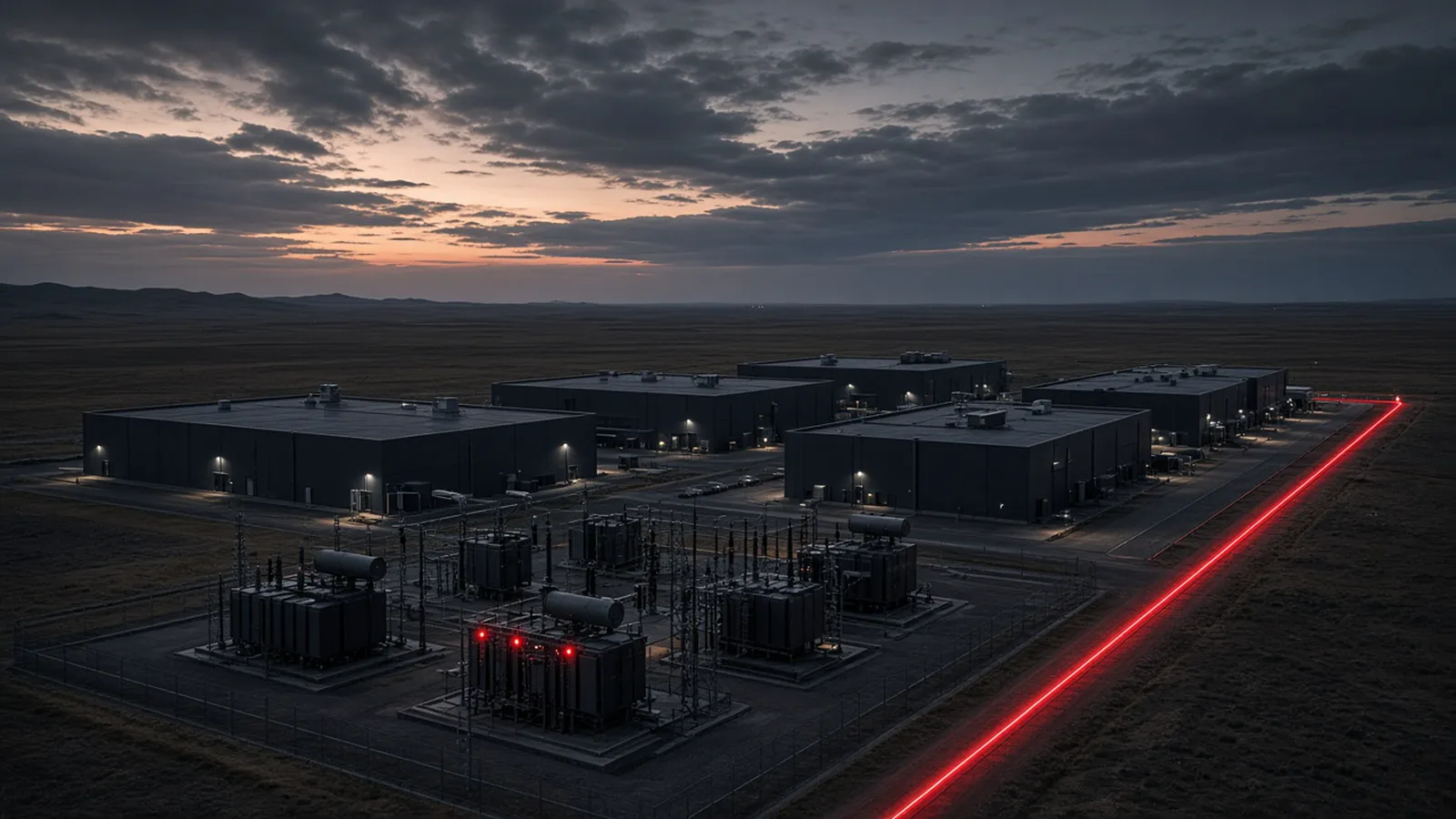
A search for the largest data center in Central Asia is not answered on the Akashi Data Center site by a ranking of halls that are already running: phase one has not launched. The scale the site publishes is the plan for the campus in Astana. On the homepage that is four DC buildings, 4,224 racks, and 100 MW of dedicated power. Other figures sit beside it: the investor block states 4,000 racks, a 63 MVA substation supply, and technical conditions for 100 MW; the technical specifications list 28 MW of IT load with no named scope; the construction page lists a planned phase-one IT load of 5.28 MW. These are not one quantity, and they are not capacity in service. The site’s positioning is the first Tier IV data center in Central Asia by design. Phase one holds TCDD, not TCCF.
What does the site count as scale: racks, buildings, hectares?
The campus is street С316, site 7, Astana, an industrial site. The site area published on the site is 11 hectares. There are four DC buildings. The service technical specifications list 60,000 m² of built area across those four buildings and a 6,000 m² administrative building. Raised-floor height is 1.6 m, floor load is 2 tons per m², and there are two loading terminals with freight elevators. These are parameters in the description, not a survey of a handed-over hall.
Racks are named twice on the site, and the numbers do not match. The homepage and the cabinet rental page speak of a plan of 4,224 racks across four buildings; the commercial range “from 1 to 1,000+” is called a commercial scale there, not the engineering ceiling. The technical block on the investors page writes of four independent buildings with a total of 4,000 server racks. The site does not say which figure replaces the other. On the timeline, expansion to 4,224 racks sits at 2027+: that means 2027 and later, not racks already standing on power.
How is dedicated power different from IT load?
Power figures on the site describe different quantities. They cannot be read as steps of a single capacity that is already operating.
- On the homepage, 100 MW of dedicated power across four DC buildings. That is not a confirmed 100 MW IT load, and it is not capacity already in service.
- On the investors page the complex is described as a dedicated 110/10 kV line and substation, 63 MVA supplied, and technical conditions for 100 MW. Technical conditions are not the same thing as the 63 MVA supplied, and not the same thing as the IT load of a hall.
- The service technical specifications list an IT load capacity of 28 MW. The site does not say whether the figure belongs to a building, a phase, or the whole campus. The scope of this figure needs confirmation. It cannot be read as growth from 28 MW to 100 MW.
- The planned IT load of phase one on the construction progress page is 5.28 MW. Phase one launches in May 2027.
Separately, the campus module description publishes design figures, not a measured load of a handed-over hall. DC-1 is 5.28 MW IT and up to 15 kW per rack. DC-2 and DC-3 are 12 MW IT each and up to 30 kW per rack. DC-4 is designed for high-density AI loads: a calculated IT capacity of up to 30 MW, up to 150 kW per rack, and liquid cooling. In the same description, the design capacity of the complex after all phases is up to 100 MW. That is a figure for the project as a whole. The site does not present it as a sum of megawatts already available, and it does not describe liquid cooling as a loop that is already cooling a hall. The module layout is in the Astana campus article and in GPU cluster placement.
Published project investment is $354 million. That is project CAPEX on the investors page, not a colocation price and not a rate per kilowatt. The site does not publish list prices for the services.
How are the halls arranged if the phase has not launched?
Four buildings are the campus plan, not four handed-over halls. The current status on the construction page: the foundation is complete, and the first buildings are rising. The first server halls come online with the phase-one launch in May 2027. Until then, the conversation with the site is a configuration reservation.
Against the design IT capacity of DC-1 (5.28 MW), 5.54 MW is reserved. The pre-launch pipeline is 107% of DC-1 capacity. These are different quantities: 5.54 MW is the volume of the reservation, and 5.28 MW is the design IT capacity of phase one.
A hall for a client on the campus is not “your own data center” and not a single rack. The placement formats are a cabinet, a cage, and a dedicated server room. Which of them fits the task, when the question is the contour rather than the size of the campus, is in Colocation, a rack, or your own server room.
What reliability level is stated, and what is already confirmed?
The site calls Akashi the first Tier IV data center in Central Asia. That is a statement about the class of the design. It is not a ranking of megawatts in service, and it does not replace a certificate of the built facility.
The designed availability of a Tier IV topology is 99.995%. That is a topology calculation, not a measured outage of a hall and not a contractual percentage of a service. Phase-one design documents hold Uptime TCDD Tier IV: certification of the design, not of the built hall. The TCCF audit is planned for April 2027 and is not a certificate held today. TCDD is not TCCF. More is in Tier IV: TCDD and TCCF and on the Tier IV page.
The engineering contour the site describes for the campus: two independent feeds in an active/active scheme with 110 kV redundancy; dual electrical redundancy per building; UPS with 5/4N redundancy and up to 10 minutes of battery reserve; backup generators with 12 hours of autonomy at full load; two fuel suppliers, with delivery under a 4-hour SLA; automatic failover and load balancing. The fire contour: triple-layer detection, gas suppression, and dual redundancy of the suppression systems. Four hours is the published fuel-delivery timing, not rack availability.
Cooling in the design: free-cooling and hybrid cooling modes are designed to cut energy use by up to 40% versus a conventional scheme. The target PUE is below 1.4. These are design orientations, not a measurement of an operating hall. How they are stated is in the green engineering article.
What connectivity does the campus state?
Four independent optical entries, onto the East–West digital backbone. Two independent 110 kV power feeds; on the investors page the line is named 110/10 kV together with the substation. The campus description calls the site carrier-neutral: a specific set of carriers is not fixed in the general note, and connection options are discussed individually.
The physical address of equipment in colocation is this campus in Astana. How the choice of site relates to where data stands is in Data localization in Kazakhstan.
Where does the campus stand in this picture today?
Today the site supports all of the following at once: the site is under construction, the phase-one foundation is complete, phase-one design documents hold TCDD, TCCF has not been obtained, the commercial launch of phase one is set for May 2027, and the reservation pipeline against DC-1 capacity is 107% filled. The full rack plan and the 100 MW of dedicated power belong to the campus as a whole and to the 2027+ stage, not to a hall that is already accepting equipment.
A placement request goes on the contacts page. Sales replies within one business day and checks available power. Directly: sales.department@akashi.cloud, +7 700 810 3010.
Frequently asked questions
What does the Akashi site treat as the scale of a data center in Central Asia? The campus plan in Astana, not a ranking of halls already in operation. Four buildings, 11 hectares, 4,224 racks on the homepage and, separately, 4,000 racks in the investor block, 100 MW of dedicated power, and technical conditions for 100 MW alongside 63 MVA supplied. Phase-one halls are not in service.
Is 100 MW an IT load that is already operating? No. The 100 MW on the homepage is dedicated power, not a confirmed IT load. The 100 MW in the investor block is the technical conditions; the supply is 63 MVA. The planned IT load of phase one is 5.28 MW. The specifications separately list 28 MW of IT load with no stated scope. These figures do not add up to one operating capacity.
How many racks and buildings does the plan state? Four DC buildings. The homepage plan is 4,224 racks. The investor block writes of 4,000 racks. The site does not collapse these numbers into one. Expansion to 4,224 racks on the timeline is the 2027+ stage, not capacity already installed.
What reliability level is confirmed today? Uptime TCDD Tier IV on the phase-one design documents. That is not a certificate of the built hall. The TCCF audit is planned for April 2027. The designed availability of a Tier IV topology is 99.995%. Phase one launches in May 2027.
What connectivity does the campus in Astana state? Four independent optical entries and two independent 110 kV power feeds. On the investors page the line is stated as 110/10 kV. The campus is street С316, site 7. A set of carriers is not fixed in the general description.
Need a configuration for phase one, not a summary of the plan? Send a request to sales — we will match kilowatts to the reservation that is available.