

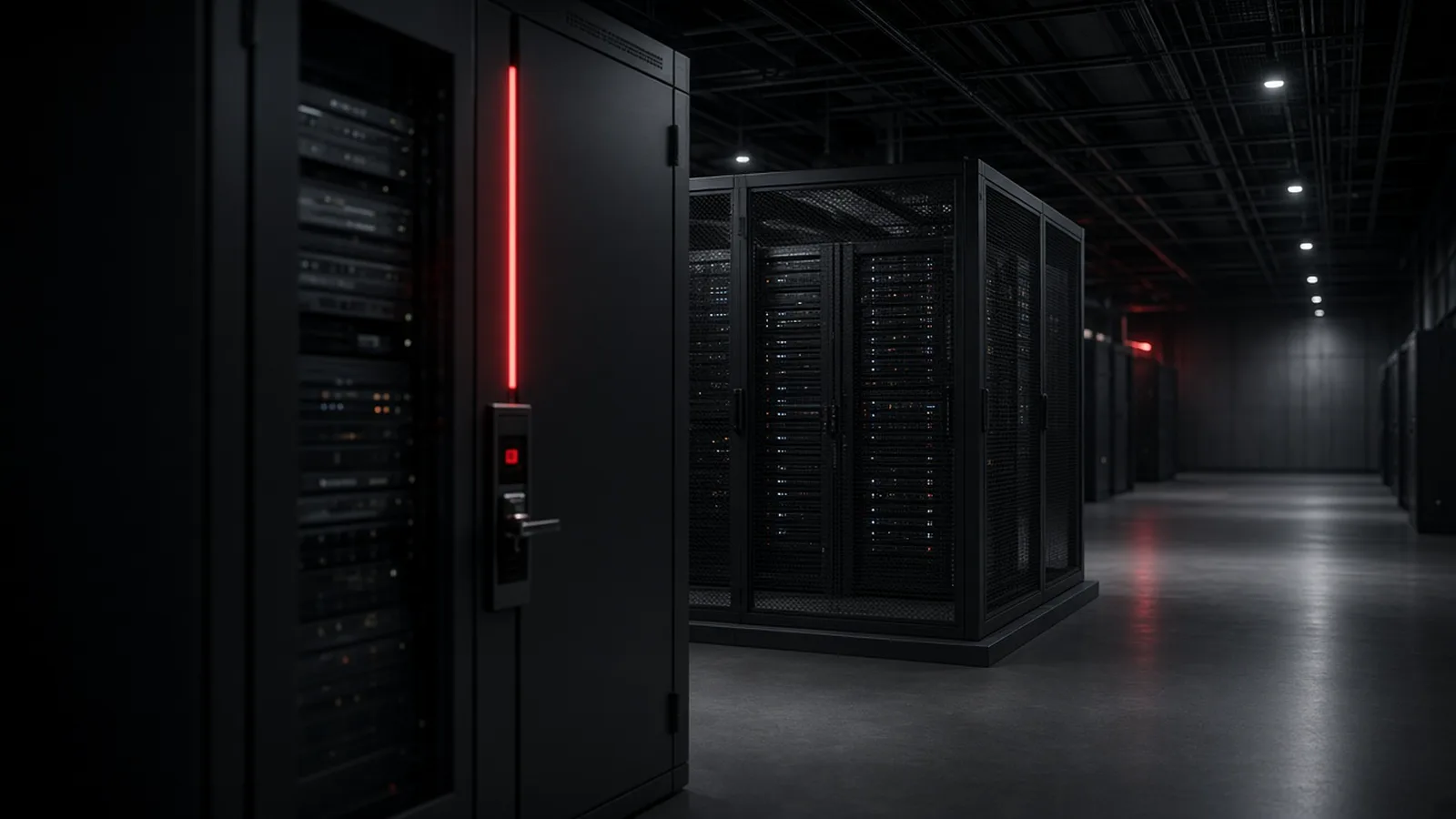
Servers in Kazakhstan can be placed in three different ways, and these are not three names for one service. Colocation means your own equipment in a commercial data center: the hardware stays with the client, and the site provides power, cooling, access, and network paths. Rack rental is a form of colocation, a ready cabinet rather than a whole hall. Your own server room is a contour the company builds and operates itself. On the Akashi Data Center campus in Astana, colocation is server cabinet rental, a cage, or a dedicated server room. A dedicated hall remains a hall on the operator’s campus, not a server room in the client’s building. Phase one launches in May 2027; until it opens, what is reserved is the configuration.
Who is colocation for?
Colocation suits a team whose servers are already theirs, or will be, and that needs someone else’s engineering contour. The site does not become the owner of the hardware and does not replace it with a cloud lineup.
Inside Akashi colocation there are three formats, and choosing a format is a separate step from choosing the model. Cabinet, cage, and hall along the path from a request are covered in Where to place servers in Kazakhstan: from the request to the rack. The question here is different: all three formats are colocation on the campus, not the construction of your own server room. If the question is how large the campus itself is, rather than which contour to choose, that is covered separately in what counts as scale for a data center in Central Asia.
Who is rack rental for?
Rack rental suits a deployment that needs one or several ready cabinets, without its own perimeter around a group of racks and without a whole hall. The service page describes the cabinet as 1200 mm wide, with coded access, two PDUs, and up to 20 kW per rack, including AI/ML. The commercial range is from 1 to 1,000+ cabinets. That is a commercial scale, not the engineering ceiling of the campus.
What the cabinet includes, how module kilowatts are read, and how a reservation differs from installation are in Server rack rental in Kazakhstan. This text does not repeat that specification.
A non-standard size is placed, on the site, in a cage: an isolated zone for several racks, with access only for authorized staff, around the clock. A whole hall with engineering set to the requirements is a dedicated server room.
When is your own server room a different contour?
Your own server room is a space where the company itself is responsible for power, cooling, access, the fire contour, and the network paths. It is not the rental of someone else’s server, and it is not colocation. The Akashi site does not publish a cost comparison between building your own server room and colocation, and it does not describe the standards by which such a room is designed. Qualitatively, the contour is yours where the team is ready to build and operate the engineering, not only to install servers.
A dedicated hall at Akashi does not replace that contour. The hall sits on the campus: cooling, access, monitoring, and fire suppression are set to the hall, the team has workspaces on site and 24/7 support, but the building and the power are the campus contour. How the hall itself is arranged is in Dedicated server room rental in Astana.
Renting someone else’s server, where the hardware belongs to the provider, is a fourth model, outside these three. How it differs from colocation is covered in Colocation or server rental.
What should you check at a data center before choosing?
Before choosing a model, it helps to match the site to the task.
- Who owns the equipment. In colocation and in rack rental, the servers are yours. In your own server room, both the servers and the engineering are yours.
- The kilowatts and the cooling scheme under which the figure applies. For a cabinet, the site states up to 20 kW. Module density is a separate design figure; it is confirmed when the configuration is calculated. How to match a load to a module is in GPU cluster placement.
- Access and remote hands. The campus has multi-perimeter access control and 24/7 CCTV. Remote hands are available 24/7 for technical operations on site.
- Network paths and power feeds. The campus has four independent optical entries and two independent 110 kV feeds.
- What is already confirmed for reliability. The designed availability of a Tier IV topology is 99.995%. That is a topology calculation, not a measured outage of the hall and not the SLA figure of a product. Phase one holds Uptime TCDD Tier IV: certification of the design, not of the built hall. The TCCF audit is planned for April 2027. TCDD is not TCCF. How to read that is in Tier IV: TCDD and TCCF and on the Tier IV page.
- What will land in the agreement, not only on the service card: availability, power per rack, remote hands, access, incident response, and acceptance. The checklist is in A colocation agreement: what to check before you sign.
- If the servers already stand somewhere else, the move is a separate contour. The steps are in the migration guide.
Criteria of class, kilowatts, and connectivity beyond a single campus are in the colocation guide.
How do you start colocation at Akashi?
The campus is street С316, site 7, Astana. The request goes on the contacts page. It helps to name the format up front (cabinet, cage, or hall — not “our own server room”), the number of racks, the kilowatts, whether a separate perimeter is needed, and a date relative to May 2027. Sales replies within one business day, by email and phone, runs a technical pre-qualification and a check of available power, and sends a proposal with prices, timing, and technical detail. The site does not publish list prices. The website is informational and is not an offer: a service is provided under a separate written agreement. An NDA is available on request. Directly: sales.department@akashi.cloud, +7 700 810 3010.
Until phase one launches, the conversation is a configuration reservation, not an installation in an open hall. Construction progress is on the construction progress page.
Frequently asked questions
Where should servers in Kazakhstan go: colocation, a rented rack, or your own server room? These are three different arrangements. Colocation is your equipment in a commercial data center. Rack rental is colocation in a ready cabinet. Your own server room is power, cooling, and access that the company builds itself. At Akashi, colocation is a cabinet, a cage, or a dedicated hall on the campus in Astana, street С316, site 7.
How is rack rental different from colocation beyond a single cabinet? Rack rental is a form of colocation: a ready cabinet, and the equipment stays yours. The cabinet page states a width of 1200 mm, coded access, two PDUs, and up to 20 kW. Your own perimeter around a group of racks is a cage. A whole hall is a dedicated server room. Both are still colocation, not your own server room.
Is a dedicated hall at Akashi your own server room? No. The hall sits on the operator’s campus: the engineering is set to the hall, but the building and the power are the campus contour. Your own server room is a space where the company itself is responsible for the engineering. The site does not publish a cost comparison of these arrangements.
What should you check at a data center before choosing? Who owns the equipment, the kilowatts and the cooling, access and remote hands, network paths, what is confirmed for the design versus the built hall, and what will land in the agreement. Phase one holds TCDD, not TCCF. The designed availability of a Tier IV topology is 99.995%. That is not the SLA figure of a product.
How do you start colocation at Akashi if the hall is not open yet? With a request on the contacts page: format, number of racks, kilowatts, and a date relative to May 2027. Sales replies within one business day and sends a proposal. Until launch, the conversation is a configuration reservation. The site does not publish list prices.
Choosing a contour for your own servers? Send a request to sales — we will look at a cabinet, a cage, or a hall, and a reservation before May 2027.