

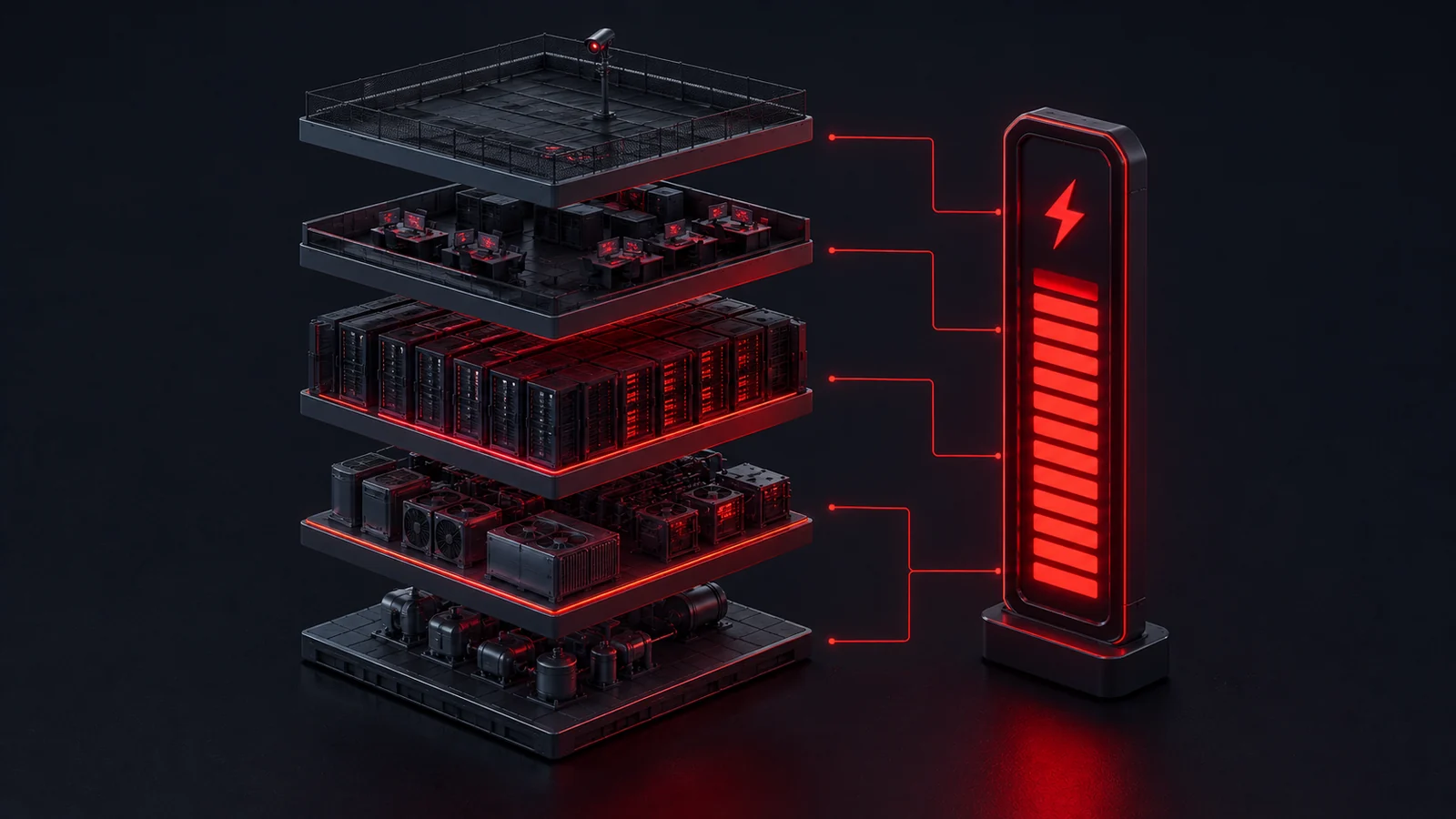
The first thing anyone asks an operator is the price per rack. That is also the first mistake: a rack is not a unit of measure. A 5 kW rack and a 20 kW rack carry the same name and four times the difference in usable load.
Below is the cost structure, and a way to bring offers from different sites onto a comparable basis.
What is on the invoice
| Line | Nature | What to check |
|---|---|---|
| Space | fixed | rack, unit or dedicated room; any “dilution” requirements |
| Power | fixed + variable | how many kW are reserved, billing model, cooling scheme |
| Connections | one-off + recurring | cross-connect pricing and lead times, carriers on site |
| Service | variable | remote hands, installation, access passes, equipment storage |
Space and power form the fixed part; cross-connects and operations the variable part. One-off installation and connection charges are easy to lose when comparing, yet they are visible in year one.
What is not on the invoice but is in the TCO
- Logistics and customs. Shipping, clearance, certification, and bonded storage when schedules drift apart.
- Depreciation of your own hardware and its refresh cycle.
- Engineer travel — where remote hands does not cover the operations you need.
- The cost of downtime. The very parameter behind the choice of reliability class: the gap between 1.6 hours and 26 minutes of designed downtime per year has a monetary value, and it is worth calculating before comparing prices.
The power billing model
The core question: are you paying for reserved capacity or for actual consumption.
Committed power — you pay for the reservation regardless of consumption. Predictable budget, and a guarantee that the kilowatts will be available as load grows.
Metered — you pay for what you use, usually on top of a reservation fee. Better for uneven load, but it demands attention to how the infrastructure factor is calculated.
PUE is also your invoice
PUE (Power Usage Effectiveness) is the ratio of the facility’s total energy consumption to that of the IT equipment. Everything spent on cooling and engineering is ultimately paid by the client. That is why free cooling, hybrid cooling and the site’s climate are not environmental marketing but a line in the calculation.
How to normalise offers
- Convert everything into a monthly cost per kilowatt of provisioned power.
- Adjust to the same reliability class — Tier III and Tier IV prices are not directly comparable.
- Add one-off charges, spread across the contract term.
- Add cross-connects in the quantity and redundancy you actually need.
- Add logistics and customs — one-off, but material.
- Estimate the cost of downtime for your workload and weigh it against the price gap.
After that the ranking usually shifts: the site that looked more expensive per rack turns out cheaper per kilowatt.
How this looks at Akashi
Akashi Data Center is designed for densities up to 20 kW per rack, with liquid cooling for high-density configurations — meaning the same usable load occupies fewer racks. Free cooling and hybrid modes deliver up to 40% energy savings, which flows directly into the client’s invoice.
Placement formats run from individual cabinets (1 to 1,000+) to a private cage and a dedicated server room under full client control. The facility is being built as Central Asia’s first commercial Tier IV data center: 100 MW of IT capacity, designed availability of 99.995%, with the first phase launching in 2027.
Frequently asked questions
What exactly does a client pay for? Space, power, network connections and service operations. Space and power are fixed; cross-connects and remote hands are variable; installation and passes are billed separately.
Why not compare on price per rack? 5 kW and 20 kW racks share a name and differ fourfold. Compare per kilowatt, adjusted for cooling and reliability class.
How is electricity billed? Either committed power (reservation regardless of use) or metered (actual use, usually on top of a reservation). Establish the model and the infrastructure factor.
What is PUE and why is it on the invoice? Total consumption over IT consumption. Everything spent on cooling is paid by the client, so free cooling has a monetary value.
When does colocation beat cloud? With a stable load over several years, configuration control requirements, and jurisdiction constraints on data.
Need a calculation for your workload profile? Contact sales — we will build the configuration in kilowatts, not in racks.