

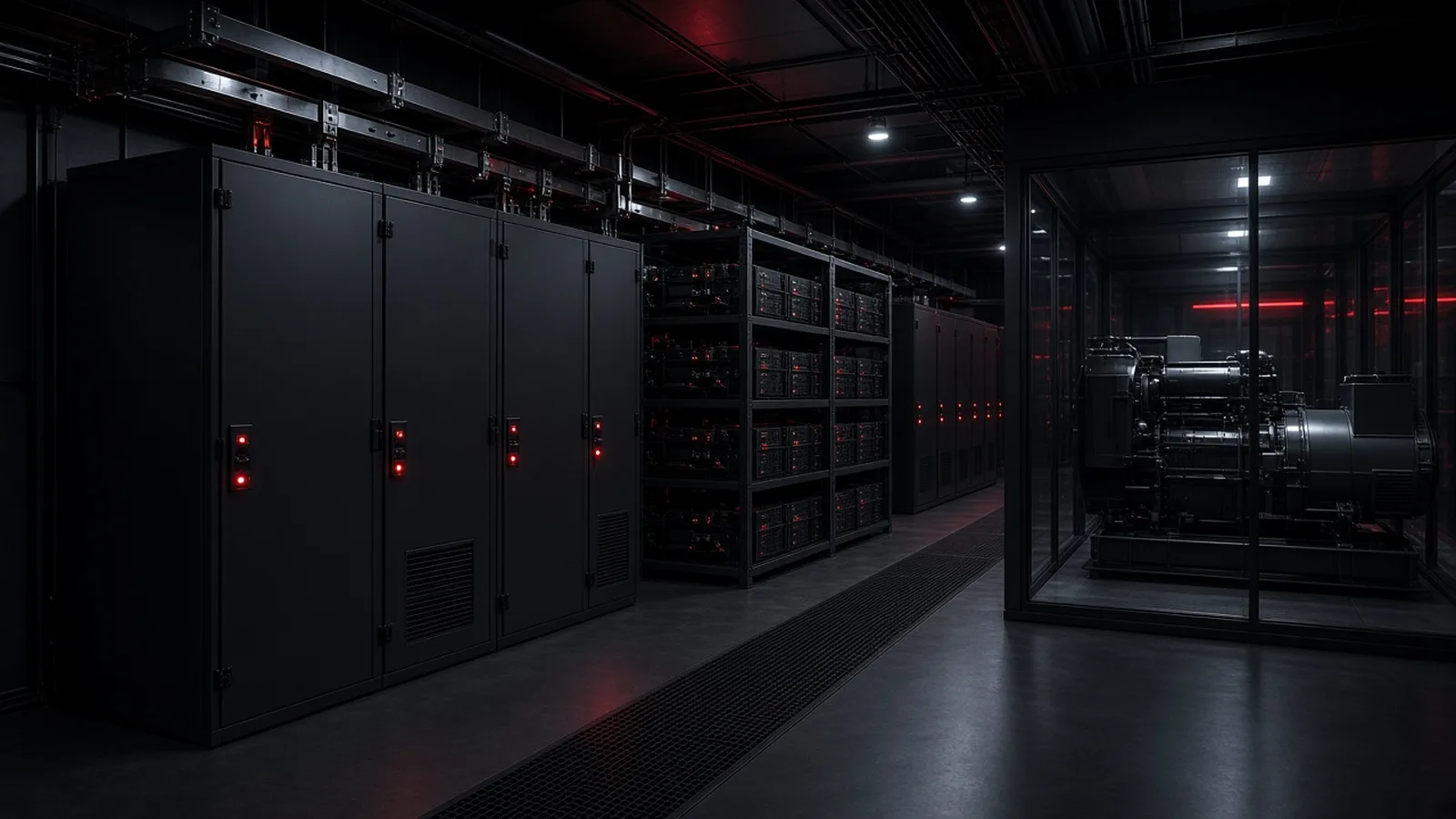
A technical director comparing colocation in Astana needs more than a hall class. They need to know what happens to the rack if one feed drops, how many minutes the battery holds, and how many hours the diesel is sized for. On the Akashi Data Center campus (street C316, site 7) power is one chain: two independent 110 kV feeds, UPS with 5/4N redundancy (five modules for a four-module load), and generators for 12 hours at full load. The placement formats are a cabinet, a cage and a dedicated server room. Until May 2027 this is a reservation of that mix.
Ask sales for the connection scheme and kilowatts for your load — name the format and the date relative to May 2027.
What “reliable power” means for the buyer
In everyday talk, “backup” often means “there is a diesel in the yard”. In colocation the chain is longer. First the grid: two physically independent feeds. Then UPS: it holds the load in the second the utility sags and gives the generators time to come up. Then diesel and fuel: without them the battery runs out and the rack goes dark.
Fault tolerance in the Akashi design is tied to independent power and cooling so that a single point of failure should not take the hall down. The project is designed to Tier IV (a design target, not a certificate of a built hall); hall handover is May 2027. How the class changes the contract is in Tier III vs Tier IV colocation.
Two 110 kV feeds, active/active, and campus power
The campus is connected to two independent 110 kV feeds in active/active: both sources run at once. If one feed drops, the second is already carrying load. Each building is designed with dual electrical redundancy; failover and load balancing are automatic.
Power figures describe different quantities and do not add up to “megawatts already on”. For a campus of four DC buildings, dedicated power is 100 MW — that is not a confirmed 100 MW IT load and not an operating hall. Phase-one planned IT load is 5.28 MW. A separate figure is 28 MW of IT without a building, phase or campus scope. How to keep those numbers apart is in the piece on campus scale. The substation side: a 110/10 kV line, 63 MVA supplied, and technical conditions for 100 MW.
All of that is campus design and technical conditions.
UPS 5/4N, battery, and 12 hours of generators
UPS redundancy is 5/4N, battery backup up to 10 minutes: the window while backup generators start. Generators are sized for 12 hours of autonomy at full load. Fuel: two suppliers, delivery under an SLA of 4 hours. Four hours is the fuel-delivery time; rack availability is locked separately in the contract.
The UPS → diesel → fuel chain is exactly what buyers ask when they compare sites on power. It belongs in the contract: kilowatts per rack or zone, the connection scheme, what happens if one feed fails. Designed Tier IV topology availability is 99.995%: a topology calculation. Measured uptime and the SLA line follow after handover.
For a dedicated hall and a cage power arrives on the same campus feeds.
Power per rack: 20 kW, and anything above
The commercial cabinet: 1200 mm wide, coded access, dual PDUs, up to 20 kW per rack, including AI/ML.
Density above the cabinet ceiling is a separate conversation: campus modules and liquid cooling (DC-4). That split is in high density and liquid cooling. In the TCO structure space and power are the standing part of the bill. Ask the team for a calculation against your kilowatts.
What to lock in before a hall reservation
Phase one launches in May 2027. Until that date you agree the format (cabinet / cage / hall), kilowatts per rack or zone, the connection scheme, and what lands in the contract. Build progress is on construction progress.
Phase-one design documents hold Uptime TCDD Tier IV: certification of the design, not of a constructed hall. The TCCF audit is planned for April 2027. TCDD is not TCCF. TCDD does not mean power already runs “as in a live Tier IV hall”.
The request form is contacts, consultation block. It helps to name at once: format and rack count; kilowatts per rack or zone; whether you need density above 20 kW; the date relative to May 2027. Sales replies within one business day, runs a pre-qualification and a capacity check, and sends a proposal with prices, timelines and technical detail. An NDA is available on request. Email and phone: sales.department@akashi.cloud, +7 700 810 3010.
Need colocation power in Astana locked in before the hall opens? Use the request link — we will go through the feeds, UPS, generators and the reservation before May 2027.
Frequently asked questions
What do two independent 110 kV feeds in active/active actually do? Both feeds run at the same time. If one fails, the hall is not left without utility power: the load stays on the second feed. That is the campus design, not a measured outage of a live hall.
What does UPS 5/4N and 12 hours of generators mean? The UPS covers a short window — up to 10 minutes of battery — while the diesels come online. Generators are sized for 12 hours at full load. Two fuel suppliers, delivery under an SLA of 4 hours. Those are design figures.
How many kilowatts per rack in an Akashi cabinet? Up to 20 kW per rack, a 1200 mm cabinet, dual PDUs. Density above that is a separate conversation: campus modules and liquid cooling. The cabinet figure is not a measurement of a handed-over hall.
Can you already move into a hall with this power? No. Phase one opens in May 2027. What is reserved now is the format and the kilowatts. Phase-one planned IT load is 5.28 MW; 100 MW is dedicated campus power across four buildings, not a live IT hall.
Does TCDD mean power already runs as a live Tier IV hall? No. TCDD certifies the design documents of phase one, not the constructed hall. The TCCF audit is planned for April 2027. TCDD is not TCCF. Designed topology availability is 99.995%; that is not measured uptime.